Page 17 January February 2018 TCA
P. 17
QUA – A TOPICAL DIGEST
related to Amateur Radio and his willingness to off bolt heads”. To use these last two as
experiment with antennas and equipment. He has examples of material in the book I risk implying
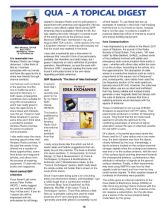
written a new eBook called Hand-carried QRP that the book is of a frivolous nature, however
Antennas that is available in Kindle for $6. As I that is not the case. It contains a wealth of
was reading the book I thought it covered much practical ideas that will be of interest to anyone
of the same ground as his previous book, who enjoys building equipment.
Minimum QRP, that I mentioned in my July/
August 2016 TCA column. I think anyone who has Cave Communication
a long‑term interest in antennas will probably not I was impressed by an article in the March 2017
Allen Wootton, VY1KX find too much new material in the book.
Box 21217 issue of Radcom, the journal of the Radio
Whitehorse, Yukon Society of Great Britain. This article, “HF cave
E: vy1kx@rac.ca I was also surprised to see a discussion of
antennas that I wouldn’t think of as particularly radio” by Mike Bedford, G4AEE, outlines some
It is remarkable how portable, like rhombics and delta loops, but I of the problems involved with safety and
Amateur Radio can bridge guess it depends on one’s definition of portable emergency radio communication from inside a
distances. I often think of operation. Nevertheless, as was the case with cave – whether with others also within the cave
this as I maintain Minimum QRP, I enjoyed reading this book and I or on the surface. According to the article, at a
schedules with my friends found it stimulated some of my own ideas first approximation “the absorption of radio
and have the opportunity to regarding portable antennas. waves in a conductive medium such as rock is
make new friends through proportional to the square root of frequency”
chance contacts. QRP Quarterly “The Best of Idea Exchange” and, consequently, cave radios have used the
low frequency section of the radio spectrum,
I’ve had two such contacts A second typically around 87 kHz. However, the antennas
in the past few months: book that I these radios use are so short and inefficient
one in California and a read that they barely radiate and instead mostly
second in Germany. In recently was generate a near magnetic field that decays with
both cases, propagation given to me the cube of distance, whereas that from a
conditions were suitable for by my friend radiating antenna would decrease with the
long CW conversations Keith square of distance.
and it was really great to Gosse,
have the opportunity to VE7ECK. These considerations led a group of British
share ideas and interests Amateurs to experiment with HF radios. Their
over the air. I hope to meet This book is experiments produced a number of interesting
these Amateurs in person published by results. They found that the 40 metre band
the QRP
some time and I think what seemed to provide the optimum for the
a wonderful medium Amateur conflicting parameters of amount of signal
Amateur Radio provides Radio Club absorption versus the size of antennas suitable
for person‑to‑person International for use within a cave.
communication. and is
available Of a dipole, a horizontal grounded dipole like
I also really enjoy the many from that those used for LF cave radios and a one metre
learning opportunities that club. loop, the best radiation was from the dipole,
Amateur Radio provides. In closely followed by the loop. Interestingly, a
the past few weeks it has I really enjoy books like this which are full of dipole antenna located on the surface received
offered me a number of useful ideas and helpful suggestions that can stronger signals when the underground antenna
easily be put into practice. The book is divided
these opportunities, some was end on to the surface antenna, with the end
from books and magazine into seven sections: 1) Components; 2) Circuit of the surface dipole pointing downward towards
articles, and others from Design; 3) Test & Measurement; 4) Tools & the underground antenna, a phenomenon they
the process of repairing Techniques; 5) Repairs & Modifications; 6) attribute to refraction of signals at the ground‑
equipment. I’ll start with the Antennas; and 7) Miscellaneous Ideas. In the surface interface. Finally, in their experiments
“Tools & Techniques” section, Keith really liked
books and magazines. they tried using WSPR to see how far their
the simple solder roll holder that is shown in the signals could be heard and from how far they
Hand-carried QRP cover photo above. could receive signals. To their surprise ranges of
Antennas Since I have been doing quite a lot of building hundreds of kilometres were possible.
If you haven’t yet come lately (not electronics‑related, unfortunately), I got The article gives an Internet reference to the
across Peter Parker, a rueful laugh from a contribution entitled Cave Radio & Electronics Group (CREG) at
VK3YE, I really suggest “Common Shop Tools Explained” by Rob http://bcra.org.uk/creg/ that is involved with this
you visit his website at Matherly, W0JRM, in the same “Tools & work. Unfortunately, most of the material at this
http://vk3ye.com/. If you do Techniques” section. There Rob defines a Skill link requires a subscription, but the site does
I expect you will be Saw as “a portable cutting tool used to make give a sense of the various projects being
impressed with his studs too short” and vise‑grips as being undertaken by this group.
enthusiasm for all things “generally used after pliers to completely round
15