Page 24 January February 2018 TCA
P. 24
Figure 3: VLF tuning coil: There had been great strides in tuning
487 mH 148 Ohm DC coil engineering, with frequent trips to
resistance.
well‑endowed junkboxes whilst keeping in
There were interesting the scrounging philosophy of Amateur
events when the signal Radio by avoiding all costs. Two geared
would suddenly motors were arranged to twist the wire
disappear. On returning strands together and to wind them on
to the shed to see what Perspex spindles. A magnificent tuning
went wrong, I was coil (see Figure 3) resulted. Sadly, my
greeted by a coil that epitome of creativity was short‑lived; it
had fried itself again. succumbed to flashover at 1/3 amp. A
With tens of kV (quite less optimal design allowed 1/4 amp and
invigorating if it found its around 10 uW ERP. The Traynor amp was
way to a carelessly now putting out 30 watts so efficiency was
placed finger) high abysmal. Accordingly, it came as a
gradients between all complete surprise when Paul Nicholson, a
the tiny wires in the coil VLF expert and EbNaut author in
were difficult to avoid Todmorden, England had detected the
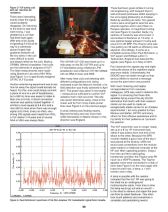
and always lethal (to the coil). Markus, The VO1NA VLF CW was heard up to a signals (see Figure 4) in May of 2017.
DF6NM, offered consolation: fried coils mile away on the DC VLF RX and up to
are the hallmarks of progress at VLF! 2.7 kilometres using a National LF10 Paul observed the signals day and night,
The field measurements were made preselector and a Marconi XH‑100 refitted noting the phase of the nighttime signal
using Spectrum Lab and a Mini Whip with an SRA‑8 mixer and DDS. was more stable. Unfortunately, the
(see Figure 1) or a specifically designed DOCXO was not stable enough so that
DF7FC VLF E‑probe. After many fried coils and tinkering with serious efforts to receive a message
different configurations and, being across the pond were unsuccessful.
Another entertaining experiment was to see motivated much like Marconi himself, a far
how far away the signal could actually be field detection was finally achieved in April With much tinkering and helpful
heard. For this, one could simply connect 2017. The power was about 5 microwatts correspondence from overseas
a piece of wire to a set of headphones, – miniscule but sufficient to confirm VLF colleagues, GPS was used to stabilize the
but a 500 Hz tone was easier to listen to radiation had in fact occurred. The site signal. It is amazing that these little
than one at 8 kHz. A direct conversion was seven kilometres away, close to the satellites flying around the sky 20,000
receiver was quickly tossed together. It ocean and far from noisy mains power kilometres from Earth with their caesium
emitted a loud squeal at 8.8 kHz and a lines (see Figure 2 on the previous page). clocks can be used to create an
nice 500 Hz tone when there was enough exceptionally stable carrier for an Amateur
signal at 8.3 kHz. Every so often, very A small iceberg was floating nearby. experimenter. I am very grateful to Paul,
strong CW signals were heard from RDL, Beyond the berg and over more than Markus and Stefan, DK7FC and many
a VLF station in Russia and of course 3,000 kilometres of Atlantic Ocean in this others for their effusive assistance and to
NAA in USA was always there. direction was England. my family for their patience as I pursued
this passion.
The VLF transmitter was no longer neatly
set up in a 6' by 19" instrument rack,
rather it was strewn from one end of the
shack to the other. Because the GPS
module needed a good view of the sky it
was placed at the window. USB and
sound card connections from the module
were made to a notebook computer at the
HF and 160m operating position. Output
from the card fed a decoupling
transformer and then the Traynor amp PA
input via a VO1FR preamp. The Traynor
speaker wires were connected to a slab of
birch (see Figure 5 on the next page) with
brass knurled nuts, a lamp, a 1 ohm
resistor and a relay.
A lamp in parallel with the resistor
indicated that the VLF RF was going to
the shed via an underground
multiconductor cable. From time to time
the lamp would go out and so would I –
to the shed to retrieve and repair the poor
coil from its latest flashover. This often
took much patience and sometimes a
Figure 4: Paul Nicholson’s spectrum of his first Amateur VLF transatlantic signal from Canada. complete and painstaking rewind.
22