Page 38 January February 2018 TCA
P. 38
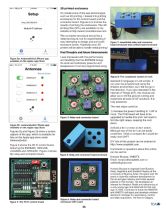
3D printed enclosures
To include some of the new technologies,
such as 3D printing, I looked into printing
enclosures for the control board and the
connector board. Figures 5 to 8 show the
results of printing the enclosures. The 3D
printing files (STL) are available on my
website at http://www.horaciobouzas.com.
The connector enclosure should be a
metal enclosure, but for experimenting it
was interesting to design and print both Figure 7: Assembled relay and connector
enclosure boxes. Hopefully soon 3D board enclosure and control board enclosure
printers will be able to handle metal printing!
Final Thoughts and Future Enhancements
I was impressed with the performance
Figure 2a: AntennaSwitch iPhone app
available on the Apple App Store and flexibility that the ESP8266 brings.
Its small and extremely powerful and
inexpensive! It can be programmed using
Figure 8: The completed system at work
standard C language or LUA scripts. It
can even be programmed using the
Arduino environment, but I did not go in
that direction. If you are interested in the
Internet of Things (IoT), this module will
allow you to hit the ground running and
implement all sorts of IoT solutions. It is
truly awesome.
The next steps could be:
1) Increase the power handling to 1 kW or
more. The PCB board will have to be
Figure 4: Relay and connector board upgraded to handle this and I will need to
find the right relays, keeping the cost
down.
Figure 2b: AntennaSwitch iPhone app
available on the Apple App Store 2) Build a 6x1 or even an 8x1 switch.
Figures 2a and Figure 2b show a screen Although two of the 4x1 can be easily
capture of the app, which is available for combined, I think a compact 8x1 would be
free on the Apple app store under really nice UHF?
AntennaSwitch. DIY kits of this project can be ordered at
Figure 3 shows the Wi‑Fi control board, http://www.snaptekk.com.
featuring the ESP8266, 74HC238, Comments or questions about this article
ULN2803 and 74HC4051. Figure 4 shows can be sent to:
the relay and connector board. Figure 5: Relay and connector board enclosure
Horacio Bouzas, VA6DTX
Email: horacio@snaptekk.com or
va6dtx@gmail.com
Horacio Bouzas is originally from Buenos
Aires, Argentina and Studied Physics at the
University of Buenos Aires. He spent over 30
years in scientific software development in
the oil and gas industry and holds several
patents in this domain. He developed an
interest for Amateur Radio and electronics at
a very young age and obtained his first call
sign in 1972. Currently he holds the KG5DTX
and VA6DTX call signs and develops wireless
electronic modules for automation, control
and data acquisition. He lives in Calgary.
Figure 6: Relay and connector board
Figure 3: The Wi-Fi control board enclosure with board
36