Page 11 January February 2018 TCA
P. 11
FT8 RC3
The next release candidate of FT8 has proven to be quite
useable! Let’s hope the final release in the spring will give us a
very flexible and useful DX tool!
Bandplans
RAC’s bandplanning committees have been effective in
establishing and defining our occupation of the allocations for
the Amateur Service in Canada, and its an ongoing living
document that needs some attention. There are a number of
bandplan issues that have been bubbling around for quite a
while, and they need to be considered and adjusted
accordingly. I have included some of these below.
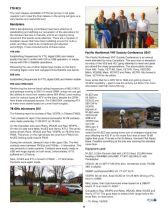
144 MHz Pacific Northwest VHF Society Conference 2017
Establishing frequencies for FT8, digital EME and meteor The Pacific Northwest VHF Society Conference is an annual
scatter that don’t conflict with CW or SSB operation, or cause event attended by many Canadians. This year was no exception
issues with FM or Satellite operations. as many of the VE6 and VE7 gang attended to meet and greet
Reviewing the use of other digital type modes on the band and attend the many presentations. The above photo shows
including digital voice and repeaters/links/Satellite sub bands. (from left): Trudy, VE7TJM, Dave, VE7HR, Terry, VE6CSO,
Mitch, VE6SM, Mark, VE7AFZ and Peter, VE7PS. My thanks to
222 MHz Dave, VE7HR for the photo.
Establishing frequencies for FT8, digital EME and meteor scatter. Dave writes that he is QRV 80 to 1296 and getting close to
902 MHz/1296/2304 10 GHz capability – glad to see the activity out there! For more
information visit http://pnwvhfs.org.
Reinforcing the narrow band calling frequencies of 902.1/903.1
and perhaps moving to 902.1 to avoid QRM, unless we can get
the utilities to move their meters above 904 MHz(!) and making N1JEZ was
room for various types of ATV on the band, despite the QRM 59 SSB to
from these unlicensed devices. For 1296/2304, realigning ATV VE2UG and
to make more sense based on current technologies. 599 CW to
VE3FN.
78 GHz Microwave DX! Signals at
The following report is courtesy of Ray, VE3FN, in Ottawa (FN25): N1JEZ were
VE2UG 59
“I am pleased to report that several successful W/VE contacts SSB and
were made yesterday 11/09/2017 on 78 GHz. VE3FN was
3x3 CW.
On the Canadian side were Rene, VE2UG and Ray, VE3FN, Although, it
On the US side were Mike, N1JEZ and Henry, KT1J. The photo should be
below shows Rene, VE2UG and Ray, VE3FN, on 78 GHz from noted that N1JEZ was seeing some sort of wideband signal that
FN35. The photo on the right shows the shot from FN34 from was affecting his 432 IF so his noise floor was at least 10 dB
N1JEZ looking north toward FN35. higher that usual. This site is the St Albans, Vermont FAA Radar
During the contacts, dewpoint was in the upper 20s. The first Base. Possibly something at the site was causing the elevated
contacts were between FN35ja and FN34jx – 5 kilometres. This noise floor.
was primarily to tests systems. Contacts were easily made in Equipment used:
SSB with huge signals on both ends. Unfortunately, KT1J
suffered an LO failure. N1JEZ: 0.25m Procom dish with LX1DU feed. DL2AM mixer
feeding a WA1MBA LNA/AMP. FT‑817 432 MHz IF with
Next, N1JEZ and KT1J moved to FN34lt. – 27 kilometres. Panadapter.
Contacts were again made.
VE2UG: 30 cm MTI 71‑86 GHz dish. Homebrew mixer. PCOM
39G multiplier.
DB6NT synthesized MKU LO. FT‑817 for IF.
VE3FN: 30 cm dish. Axtal OCXO at 101.25 MHz driving a PLL
brick to 12960
MHz, tripler, then Sub‑harmonic mixer based on a DB6NT
board. IF is an Icom IC‑402A.”
Congrats to Ray, VE3FN and Rene, VE2UG, Mike, N1JEZ and
Henry, KT1J! The guys hope to extend their range before the
snow flies, so stay tuned.
– 73, Dana, VE3DS
9